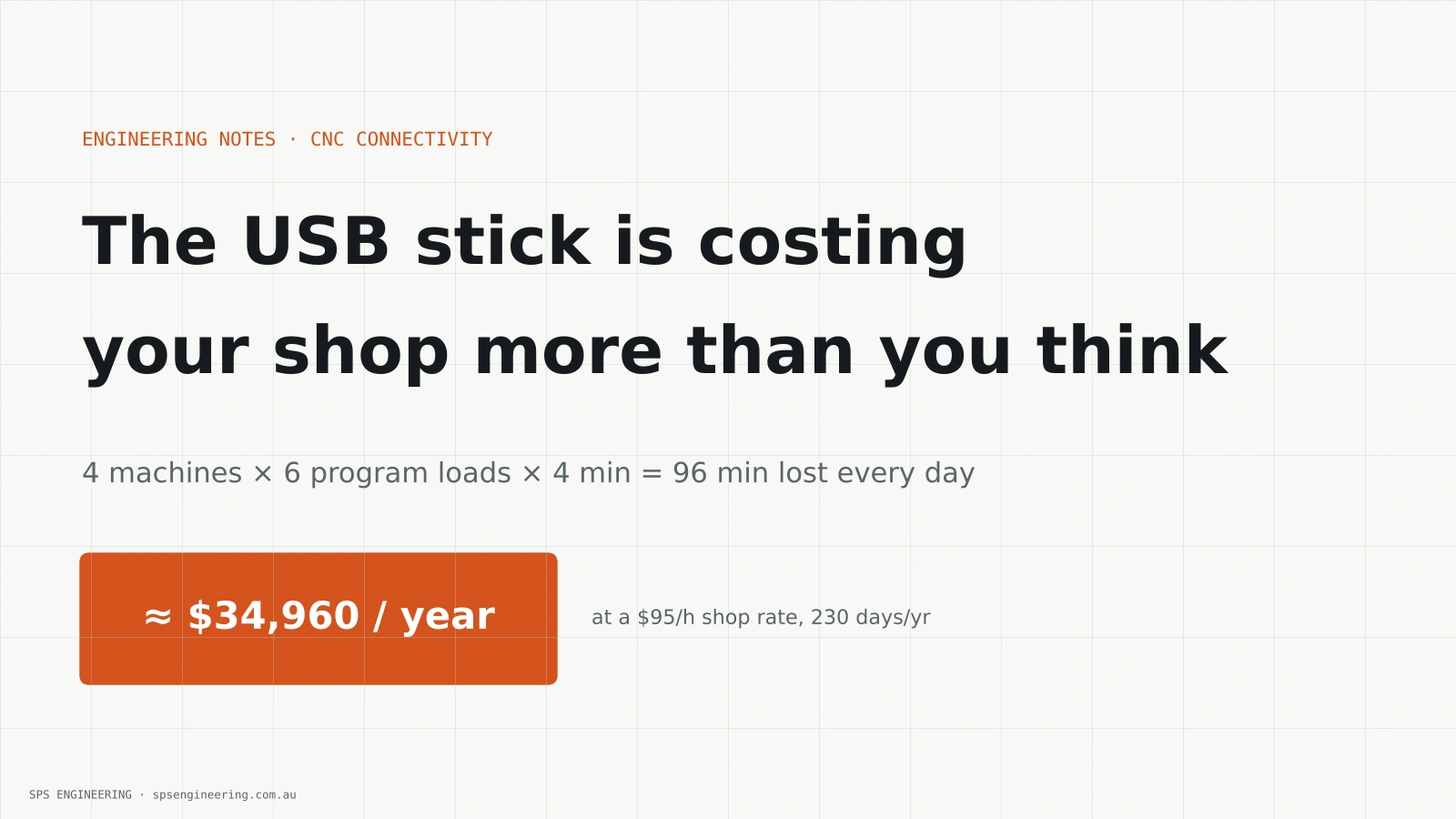
The USB stick is costing your shop more than you think
Nov 9, 2026
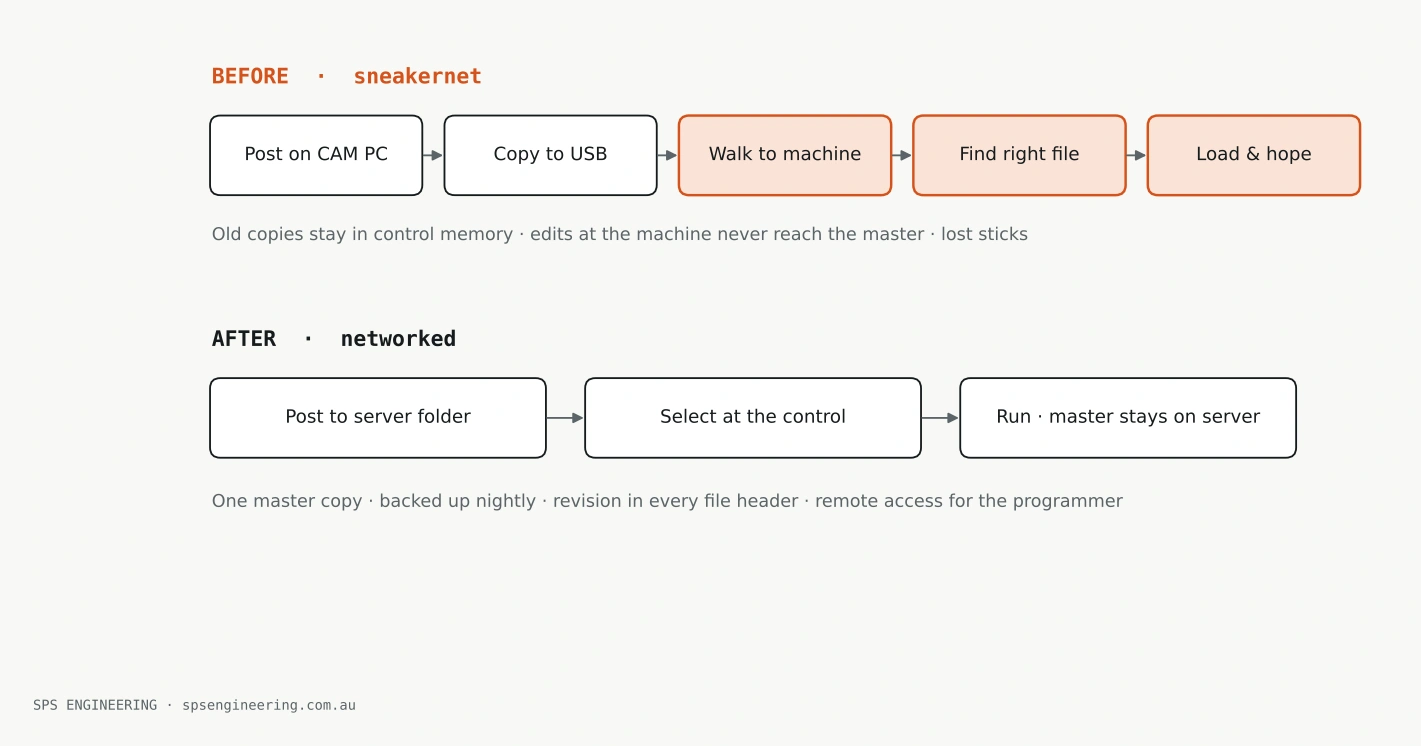
In many WA job shops, CNC programs still travel the same way they did fifteen years ago. Someone posts the file on the CAM PC, copies it to a USB stick, walks it to the machine, hunts for the right file in a folder full of names like PART_FINAL_v3_NEW, and loads it. It works, so nobody questions it.
The problem is that it works just well enough to hide what it costs.
What machinists say about it
Read any machinist forum and the same complaints come up again and again.
The wrong version runs. An old copy sits in control memory, the operator loads it, and the first sign is a scrapped part.
Edits made at the machine disappear. The setter fixes a feed or an offset at the control, and the change never makes it back to the master file. Next time the job runs, the problem comes back.
Sticks go missing or fail. Controls are fussy about stick size and format, and a corrupted stick at 6 am stops a machine.
Control memory is not a backup. A flat battery, a reset or a firmware update can wipe what is stored on the machine.
None of these are dramatic on their own. Together they are a steady leak of spindle time and scrap.
Work out what it costs you
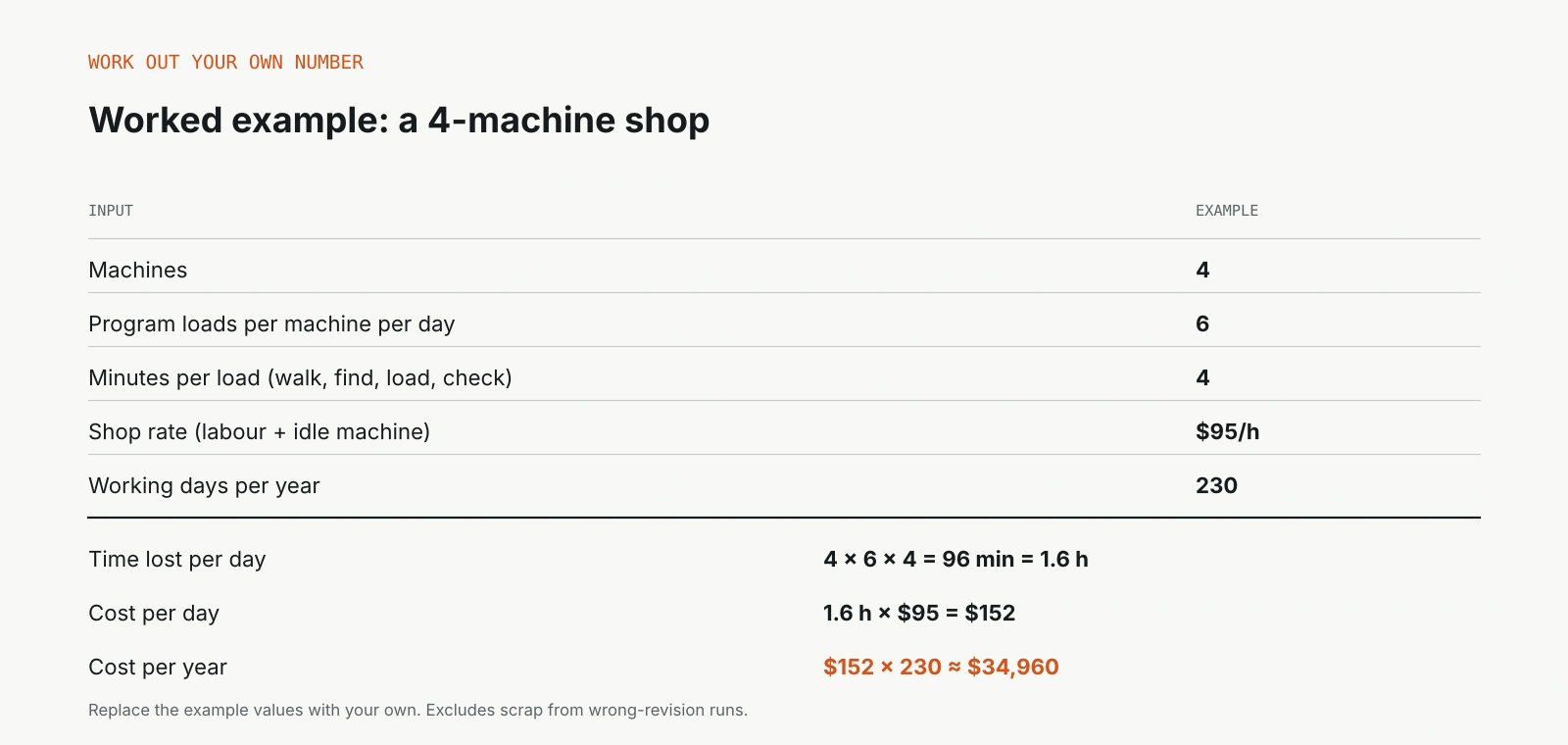
Take a conservative example: a shop with 4 machines, 6 program loads per machine per day, and 4 minutes per load to walk, find, load and check. That is 96 minutes a day, or 1.6 hours. At a shop rate of $95 an hour for labour and idle machine time, that is $152 a day. Over 230 working days it comes to about $34,960 a year.
That is before counting a single scrapped part from the wrong revision. On a high-value casting or a long cycle, one wrong-version run can cost more than a month of walking. Swap in your own numbers; the worked example is in the image with this post.
What "networked" actually means
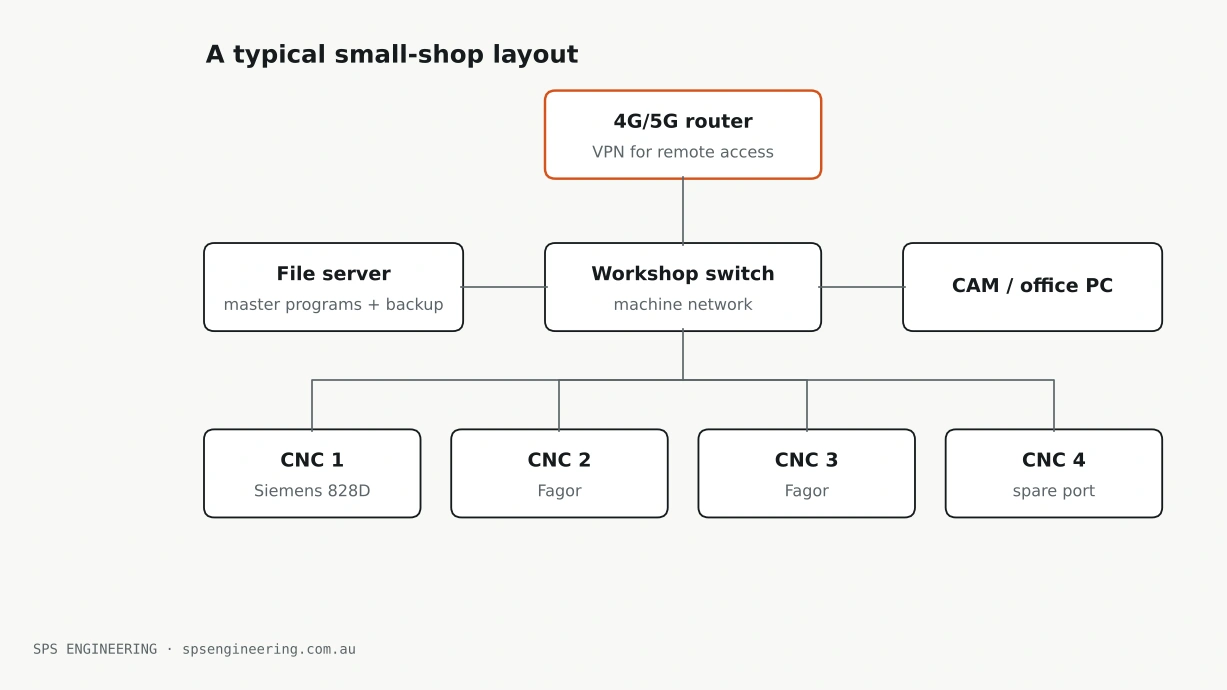
You don't need an expensive MES system. For most small shops the fix is simple. Put the machines, the CAM PC and a small file server on one workshop network. Give each machine its own master folder on the server, and have the control read programs straight from it. Back that folder up every night and keep a copy off site. Put a header in every program with the part number, operation, revision, date and who posted it. Add secure remote access over 4G or 5G so the programmer can send or check a file without driving in.
The rule that makes it work is simple: the server copy is the master, and control memory is only a working copy. If a change is made at the machine, it goes back to the server as a new revision.
Which controls can do it?
Most controls built in the last 15 years have an Ethernet port, and many can read from a network drive. The Siemens SINUMERIK 828D and 840D sl can map a network drive, but on some 828D machines the network-drive function is a software option that has to be enabled, so check this before buying anything. The Fagor 8055 uses its own method for its remote disk, while the 8060 and 8065 connect to shared folders more like a Windows PC. Older serial controls can still be connected through a serial-to-Ethernet adapter and drip-fed from the server.
The details vary by model and software version, so the first step is always a survey of what each control actually has.
Does it pay back?
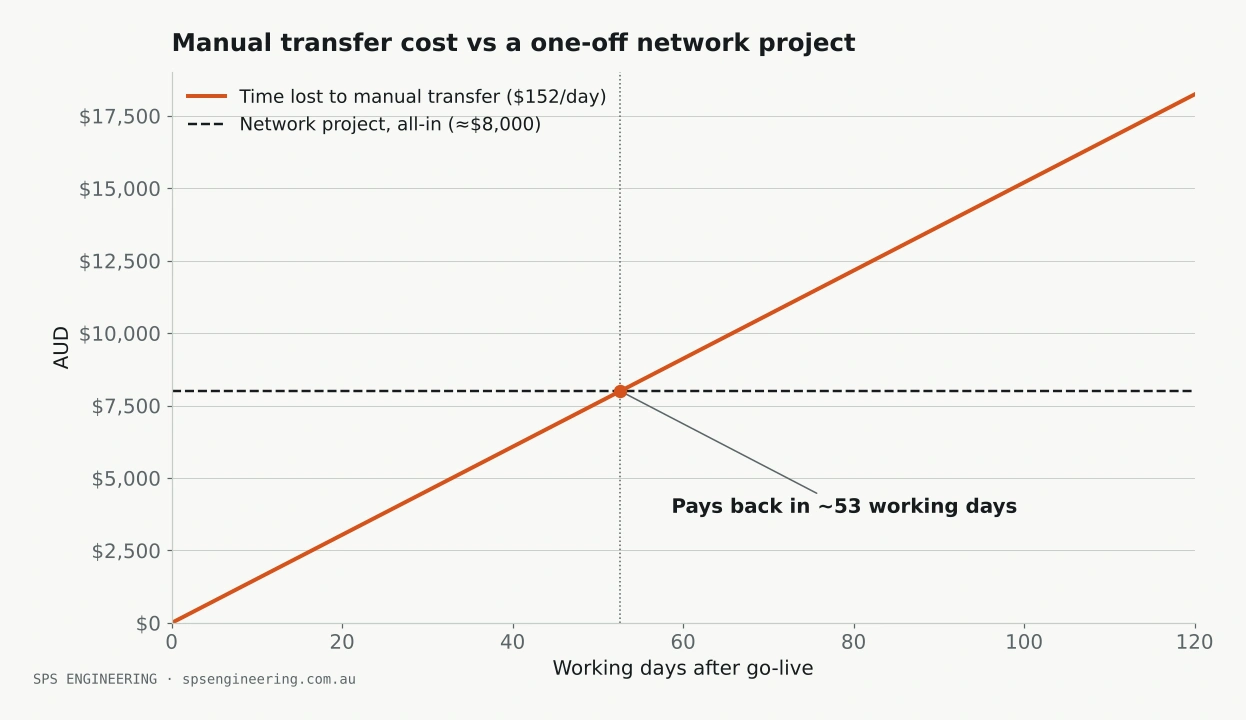
For a four-machine shop, a typical all-in project covering network hardware, server, controller setup, remote access and documentation lands around $8,000. Against $152 a day of lost time, that pays back in roughly 53 working days, or about two and a half months.
Your numbers will differ. A shop with long cycle times and few program changes will pay back more slowly. A high-mix shop with ten changeovers a day will pay back faster.
Where to start
Count program loads on each machine for one week. Time five of them, from file posted to cycle start. Note every wrong-version or lost-file incident in the last year. Then put those numbers into the worked example.
If the answer is more than a few thousand dollars a year, it is worth a closer look.
SPS Engineering connects CNC machines, PLCs and plant equipment for WA manufacturers. A fixed-price $750 Connectivity Survey checks every control, designs the network and gives you a fixed install quote. Book at spsengineering.com.au.
Parsa Sajedi is a Chartered Professional Engineer (CPEng, NER) based in Perth.